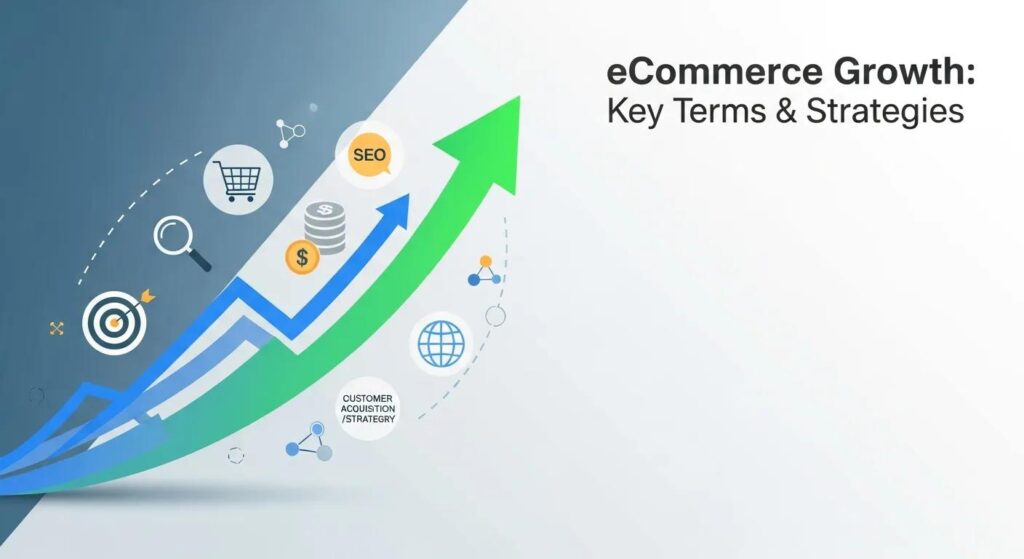
eCommerce Growth: Key Terms & Strategies
Understanding the language of eCommerce growth converts confusing dashboards into clear decisions that drive revenue. This glossary defines core eCommerce marketing terms, performance metrics, business models, UX concepts, and integrated strategies so merchants can act on data and prioritize growth initiatives. Many online retailers struggle to translate terms like CLV, AOV, CRO, and omnichannel into concrete steps; this guide closes that gap by pairing definitions with tactical next steps and measurement formulas. After the definitions, you’ll find comparison tables, optimization checklists, and actionable tactics that map each term to growth levers you can test immediately. GSM Growth Agency, an eCommerce lead generation and information hub, authored this resource to help teams move from understanding to execution and to offer a consultation pathway for merchants who want tailored prioritization. Read on to learn key marketing concepts, critical metrics, operational models, user experience impacts, and integrated strategies that shape scalable online businesses.
What Are the Key eCommerce Marketing Terms Every Online Retailer Should Know?
This section defines high-impact marketing terms every online retailer should track and use to shape acquisition and retention strategies. Each definition includes why the term matters to traffic, conversion, or customer value and a tactical next step you can implement. Understanding these marketing hyponyms—Search Engine Optimization, Pay-Per-Click, Email Marketing, Affiliate Marketing, and Social Commerce—reduces wasted spend and improves channel ROI. GSM Growth Agency’s take: prioritize SEO and measured paid channels while testing creative and segmentation, and consult with an SEO optimization specialist or ad management team to align tactics to goals.
What Is Search Engine Optimization and Why Does It Matter for eCommerce Growth?
Search Engine Optimization (SEO) for eCommerce is the practice of improving product and category pages, technical site health, and structured data so organic search drives qualified traffic and conversions. SEO matters because high-intent organic visits typically convert at better rates and cost less over time than paid acquisition, making it central to long-term growth. Tactical steps include optimizing title/meta tags for purchase intent, implementing structured data (product schema) to increase rich results, and improving internal linking from category to product pages. How GSM helps: GSM Growth Agency offers AI-powered store SEO services that combine technical audits, on-page automation, and content strategy to increase organic visibility; the agency has managed substantial digital ad spend and revenue outcomes that inform SEO-prioritization decisions.
- Core SEO actions to prioritize: Optimize product titles and meta descriptions for buyer intent. Implement structured data to qualify for rich snippets. Improve internal linking and canonicalization to distribute authority.
These actions typically lead to higher organic traffic and more efficient CAC when combined with content that answers buyer questions and transactional queries.
How Does Pay-Per-Click Advertising Drive eCommerce Sales?
Pay-Per-Click (PPC) advertising uses paid placements—search, shopping, social, and retargeting—to drive immediate acquisition and scale revenue by bidding on buyer intent or audience signals. PPC drives volume quickly, complements organic SEO, and provides measurable ROAS and CPA metrics to guide spend allocation across channels. Key optimizations include audience segmentation and creative testing to improve CTR and conversion rate, and leveraging dynamic shopping ads to showcase relevant products to high-intent shoppers. How GSM helps: GSM Growth Agency provides ad account management and creative testing services informed by managing over $16 million in digital ad spend, helping clients scale efficient ROAS through structured experiments and audience refinement.
This section delves into the effectiveness of paid advertising in driving immediate sales and scaling revenue.
- PPC optimizations that improve performance: Segment audiences by behavior and purchase intent for tailored creatives.Use retargeting sequences to recover potential buyers and increase LTV.Test creative formats and messaging to reduce CPA and increase ROAS.
These tactics make PPC a powerful lever for scaling while teams build organic channels.
Which eCommerce Performance Metrics Are Critical for Measuring Business Growth?
This section explains the metrics that determine whether growth is profitable and sustainable, with formulas and action-oriented guidance for each. Tracking AOV, CLV, CAC, ROAS, and Conversion Rate clarifies unit economics and prioritizes where to invest for scale. GSM Growth Agency’s take: focus first on conversion rate and CLV to ensure acquisition spend scales profitably; use CRO and retention strategies to improve payback periods and marketing efficiency.
Before the comparison table, remember that metrics must be measured consistently and segmented by cohort to avoid misleading averages and to support data-driven experimentation.
This comparison highlights how increasing AOV or CLV improves unit economics more sustainably than solely raising traffic; prioritize levers that improve per-customer value before scaling ad spend.
What Is Average Order Value and How Does It Affect Revenue?
Average Order Value (AOV) is the average dollar amount customers spend per transaction and directly multiplies with traffic volume to drive revenue. Improving AOV is one of the fastest ways to increase top-line revenue without acquiring more customers—common levers include upsells, bundles, and free-shipping thresholds. A simple formula is Total Revenue divided by Number of Orders; monitor AOV by channel and cohort to see where offers land best. How GSM helps: GSM Growth Agency implements CRO copy, upsell flows, and pricing experiments as part of conversion and creative services to increase AOV, using ad and creative learnings from their managed spend to structure tests that lift order value.
Understanding how to increase the average amount a customer spends per order is a key strategy for boosting overall revenue.
- AOV improvement tactics: Add one-click upsells on checkout confirmation or product pages. Create bundles or curated kits with perceived value. Use shipping thresholds to increase cart totals.
Measuring AOV impact on profit and conversion ensures increases are net positive.
How Is Customer Lifetime Value Calculated and Why Is It Vital?
Customer Lifetime Value (CLV) estimates the total revenue a customer will generate across their relationship and is crucial for determining sustainable acquisition budgets. Use a simple CLV formula (AOV × purchase frequency × average customer lifespan) as a baseline, then refine with cohort analysis and margin-based CLV for accuracy. CLV informs how much you can spend to acquire customers profitably and which retention tactics yield the best ROI; small increases in retention can dramatically raise CLV. How GSM helps: GSM Growth Agency leverages email marketing, retention flows, and CRO optimization to extend customer lifespan and increase repeat purchases, aligning acquisition spend to real customer value and improving payback periods based on managed performance data.
- Ways to increase CLV: Implement subscription or replenishment programs.Run lifecycle email and SMS campaigns targeted to past purchasers.Personalize offers based on purchase history and segmentation.
Focusing on CLV ensures growth is profitable as scale increases.
What Are the Most Common eCommerce Business Models and Operational Terms?
This section clarifies business models that shape margins, fulfillment complexity, and customer experience so merchants can choose operations aligned to growth ambitions. Models covered include Dropshipping, B2B, B2C, and Omnichannel fulfillment—each changes inventory strategy, lead times, and customer service requirements. GSM Growth Agency’s take: operational choices should be matched to margin targets and service capacity; consider agency support for product and supply management or virtual assistant fulfillment when scaling.
Below is a comparison table that contrasts models and their operational impact to aid decision-making for growth strategies and fulfillment planning.
This comparison shows that model choice affects margins, speed-to-market, and resource needs; align logistics and customer service to the chosen model before scaling acquisition.
What Is Dropshipping and How Does It Influence eCommerce Fulfillment?
Dropshipping is a fulfillment model where suppliers ship directly to customers, eliminating merchant-held inventory but adding dependency on supplier reliability and shipping speed. The upside is low capital requirement and fast product testing, while risks include variability in lead times, returns handling, and limited control over packaging and quality. Mitigation tactics are vendor vetting, clear shipping SLAs, and branded packaging options where possible; operations teams should monitor supplier KPIs closely. How GSM helps: GSM Growth Agency supports product and supply management plus virtual assistant support for fulfillment and customer service to reduce operational friction when merchants use dropshipping or hybrid models.
- Dropshipping operational risks: Supply chain delays impacting customer satisfaction. Higher return rates due to inconsistent quality control. Difficulty enforcing branding and unboxing experience.
Proactive supplier agreements and clear customer communication minimize negative experiences.
How Do B2B and B2C Models Differ in eCommerce Growth Strategies?
B2B and B2C eCommerce differ in sales cycles, purchase frequency, pricing complexity, and required UX: B2B often needs account-based flows, bulk pricing, and integration with procurement systems, whereas B2C emphasizes streamlined checkout and impulse conversion. Metrics also diverge—B2B emphasizes ACV (average contract value) and LTV per account, while B2C focuses on AOV and repeat purchase rate. Growth strategies must reflect these differences in messaging, UX, and sales enablement, such as personalized catalogs for B2B versus CRO-driven landing pages for B2C. How GSM helps: GSM Growth Agency offers tailored Shopify store builds and maintenance, copywriting, and team support to adapt site architecture and conversion flows to B2B or B2C requirements.
- Strategy differences to implement: Implement account management and negotiation workflows for B2B.Simplify checkout, enable guest purchase, and optimize PDPs for B2C.Align marketing channels: LinkedIn/B2B partnerships versus paid social and influencers for B2C.
Adapting KPIs and UX to the business model ensures growth efforts are efficient and measurable.
How Do Website and User Experience Terms Impact eCommerce Conversion Rates?
User experience terms like CRO, landing pages, CTAs, and checkout flow directly affect whether visitors convert, providing immediate levers for revenue improvement through design and testing. This section gives practical definitions, a CRO checklist, and a table mapping UX elements to measurable impacts so teams can prioritize experiments. GSM Growth Agency’s take: prioritize CRO audits and iterative testing on landing pages and checkout to deliver measurable conversion lifts and lower CAC.
Before the UX impact table, note that even small percentage improvements in conversion rate compound across traffic volumes to produce sizable revenue gains.
Use this mapping to create prioritized CRO roadmaps focused on the highest-impact UX elements.
What Is Conversion Rate Optimization and How Does It Boost Sales?
Conversion Rate Optimization (CRO) is a structured process of hypothesis, testing, analysis, and iteration that increases the percentage of site visitors who take a desired action, such as making a purchase. CRO boosts sales by improving the efficiency of existing traffic—small gains in conversion can dramatically reduce CAC and improve ROAS. A typical CRO cycle: identify friction points, generate hypotheses, run A/B tests, analyze results, and roll out winners. How GSM helps: GSM Growth Agency provides CRO optimization for landing pages, running systematic tests and applying design and copy improvements informed by ad performance and customer research; agency case experience shows measurable uplifts when tests are prioritized by potential revenue impact.
The strategic application of data and testing is paramount for enhancing the efficiency of website traffic into paying customers.
- CRO quick wins checklist: Improve page load speed and mobile responsiveness. Simplify forms and reduce checkout steps. Clarify value propositions and use social proof.
Applying these wins in sequence produces reliable conversion improvements that scale with traffic.
Why Are Landing Pages and Calls to Action Crucial for eCommerce Success?
Landing pages and CTAs focus acquisition messaging into a single, measurable conversion pathway; their design and copy determine how well campaign traffic converts. A high-converting landing page matches ad intent, presents a clear value proposition, and guides users to a single CTA with minimal distractions. CTA best practices include using action verbs, emphasizing specific benefits, and placing CTAs above the fold and at logical content junctures. How GSM helps: GSM Growth Agency offers landing page design and CRO services that align creatives, copy, and testing to campaign goals, ensuring landing experiences convert at top percentages based on creative and UX optimization.
Optimizing the user’s journey from initial ad click to final purchase involves carefully crafted landing pages and clear calls to action.
- Landing page design principles: Ensure message match between ad and page headline.Use a single primary CTA and reduce competing links.Include concise social proof and a clear next step.
Consistent testing of headlines and CTA language reveals the optimal combination for your audience.
How Can Integrated eCommerce Strategies Like Omnichannel and Affiliate Marketing Enhance Growth?
Integrated strategies like omnichannel marketing and affiliate programs extend reach and retention by meeting customers where they are and leveraging partners to acquire new buyers. This section defines both approaches, explains strategic benefits for CLV and retention, and provides implementation pointers to start programs that scale. GSM Growth Agency’s take: integrate channels and partnerships with measurement frameworks and consider agency support for managing affiliate or creator programs as part of a broader acquisition mix.
What Is Omnichannel Marketing and How Does It Improve Customer Experience?
Omnichannel marketing coordinates messaging and data across web, email, social, and in-store touchpoints so customers experience consistent, relevant interactions that increase retention and CLV. By syncing inventory, offers, and customer profiles, omnichannel reduces friction and enables personalized experiences that improve repeat purchase behavior. Steps to begin include auditing owned channels, centralizing customer data, and piloting coordinated campaigns that link email, paid social, and on-site personalization. How GSM helps: GSM Growth Agency supports omnichannel planning through integrated marketing and CRM-aligned tactics that prioritize retention and lifecycle flows.
- Omnichannel implementation checklist: Audit all customer touchpoints and data sources. Centralize profiles for consistent personalization. Pilot cross-channel campaigns with unified messaging.
Start with one coordinated funnel and scale as measurement proves lift in retention and CLV.
How Does Affiliate Marketing Work to Expand eCommerce Reach?
Affiliate marketing leverages partners—publishers, creators, or influencers—who promote products for a commission on referred sales, extending reach with variable cost-per-acquisition. Common program structures include fixed CPA, revenue-share commissions, and hybrid models with bonuses for high performers; tracking requires reliable attribution and fraud monitoring. Practical tips for launching include setting clear commission tiers, providing creatives and tracking links, and onboarding affiliates with performance expectations and compliance guidance. How GSM helps: GSM Growth Agency offers creator and influencer marketing support as part of broader advertising and creative services to manage affiliate relationships and creative distribution.
- Affiliate program starter steps: Define commission structures and performance tiers. Provide partners with assets and clear conversion tracking. Monitor quality and adjust offers based on ROI.
A well-run affiliate program converts partner reach into measurable, scalable customer acquisition.
What Are the Most Frequently Asked Questions About eCommerce Growth Terms?
This FAQ-style section answers common queries clearly and concisely to capture quick snippet results and help teams prioritize next steps. Short answers give practical guidance and direct action items for merchants who need quick, tactical direction. GSM Growth Agency’s take: if you need help prioritizing metrics or executing tests, book a consultation to map terms to your current growth constraints and to build a test plan.
What Are the Basic Terms in eCommerce Every Entrepreneur Should Understand?
Here are essential terms every entrepreneur should know, each with a one-line definition and an action step to apply immediately. These definitions create a foundation for building measurement and optimization systems that support scalable growth.
- SEO: Optimization for organic search to increase qualified, low-cost traffic; start by optimizing product titles.
- CRO: Systematic testing to increase conversion rates; begin with a checkout funnel audit.
- AOV: Average order value; implement one upsell to test impact on AOV.
- CLV: Customer lifetime value; run a cohort analysis to estimate payback periods.
- CAC: Customer acquisition cost; calculate per-channel CAC to prioritize spend.
- ROAS: Return on ad spend; use as an efficiency check for paid channels.
- UX: User experience; measure bounce rates and time on site to identify friction.
- Omnichannel: Coordinated cross-channel experience; pilot a unified email and ad message.
What Is the Most Important Metric for eCommerce Growth in 2025?
For 2025, prioritizing Customer Lifetime Value (CLV) alongside conversion rate offers the best path to sustainable, profitable growth because market conditions favor retention and repeat purchases over one-time acquisition. CLV guides how much to invest in CAC and which retention tactics yield compounding returns, while conversion rate improvements ensure current traffic converts more efficiently. Action step: conduct a CLV audit and pair it with CRO experiments that reduce CAC payback times. For help mapping these priorities to your business, consider a consultation with GSM Growth Agency to set a prioritized roadmap.
This final guidance ties definitions to action: measure CLV, test conversion improvements, and align acquisition spend to proven repeat value.